Dr. Daniela Ozacky-Stern’s study, “Collective Documentation from the Beginning of WWII: The ‘Rikuz’ in Vilna as a Case Study,” uncovers a remarkable yet historically neglected chapter of the Holocaust and Jewish resistance. It examines the fate of approximately 600 young members of the Zionist-Socialist youth movement Hashomer Hatzair who fled Poland at the outbreak of World War II and formed a collective sanctuary—known as a “Rikuz”—in Lithuanian-controlled Vilna between October 1939 and June 1940.
Escape and the Formation of the Collective
Following the joint Nazi-Soviet invasion and partitioning of Poland in September 1939, thousands of Jewish refugees sought safe haven. Vilna, temporarily transferred to Lithuanian jurisdiction in October 1939, emerged as a vital window of hope and a center for Jewish intellectual and political life.
Among the refugees were hundreds of Hashomer Hatzair youth, aged 17 to 19, who had previously trained on agricultural farms across Poland. Adhering to leadership directives to maintain movement continuity under any circumstances, these youngsters crossed borders—often clandestinely through smugglers near Lida—and converged in Vilna. There, they established a structured, communal framework modeled after the kibbutz lifestyle they aspired to practice in Eretz-Israel.
Daily Life, Labor, and Ideological Ferment
Life within the Rikuz was initially defined by extreme material deprivation. Hundreds of members were crowded into dilapidated former dormitories and a textile factory with no running water, heat, or proper sanitation. Despite sleeping on straw and facing chronic food shortages, the collective maintained strict discipline and self-reliance:
-
Productive Labor: Members established cooperative workshops for carpentry, shoemaking, and tailoring, while others took on external jobs or domestic labor to sustain the community.
-
Cultural Resilience: To combat demoralization, they organized daily schedules, Hebrew language classes, cultural gatherings, and access to local libraries.
-
Complex Ideological Debates: Operating under the shadow of Soviet annexation, members engaged in intense intellectual seminars. They wrestled with the profound ideological dissonance of their socialist devotion to the Soviet Union juxtaposed against the regime’s suppression of Zionism.
Extraordinary Self-Documentation
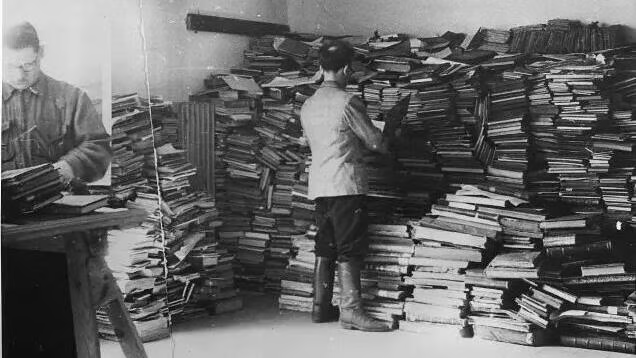
One of the most striking aspects of the Vilna Rikuz was its systematic, real-time documentation. Recognizing the historic gravity of their situation, the members maintained an open, collective diary known as the “Vilna Diary” (Yoman Vilna), alongside membership rosters, administrative records, photographs, and extensive correspondence with the movement’s executive committee in Mandatory Palestine and clandestine branches in Nazi-occupied Poland.
Before the Soviet annexation of Lithuania in June 1940 forced the Rikuz to disperse, departing members managed to smuggle this vast corpus of ego-documents to Eretz-Israel. Preserved first in Kibbutz Merhavia and later housed in the Moreshet Archive at Givat Haviva, this collection stands as a rare and pristine monument to youth movement culture during wartime.
The Historiographical Lacuna
Despite its exceptional nature, the story of the Vilna Rikuz remained largely sidelined in mainstream Holocaust historiography for decades. Ozacky-Stern attributes this omission to the political and memory-shaping dynamics of post-war Israeli society.
Traditional Zionist narrative hierarchies heavily privileged armed ghetto fighters and partisan combatants as the archetypal heroes of Jewish resistance. In contrast, many Rikuz members survived by dispersing eastward into the Soviet interior or securing early emigration certificates to Palestine. Because their resistance was social, cultural, spiritual, and documentary rather than centered on military combat, their contributions were historically overshadowed.
Conclusion
Dr. Ozacky-Stern’s article reclaims the Vilna Rikuz from the margins of history. By analyzing its rich archival footprint, the study highlights how collective organization, intellectual rigor, and meticulous documentation served as powerful psychological and communal shields. Ultimately, the Rikuz demonstrates that maintaining human dignity, ideological clarity, and historical consciousness in the face of catastrophe constitutes a profound and enduring form of resistance.
To the full article – click here…
Ozacky Stern, D. (2022). Collective documentation from the beginning of WWII: the ‘rikuz’ in Vilna as a case study. Jewish Culture and History, 23(2), 115–136.
https://doi.org/10.1080/1462169X.2022.2037220