The article focuses on an interesting Ego-Document, a unique personal diary, written by Hinda Deul. It miraculously survived and was brought to Israel, even though its writer had perished. Deul was a 35-years-old teacher, living in Oszmiana, and she describes the events which unfold during WWII and the Holocaust. She was also a member of the Oszmiana Ghetto’s Judenrat, and so had accesses to inside information.
The case of Hinda Deul from Oszmiana, who stands at the core of the paper, is certainly a story of an “ordinary” woman who had left us a “peripheral” source, a personal diary written in Polish in real-time. She is unknown to Holocaust scholars and the general public, and her role and writing had been neglected, or even deliberately suppressed, in the Holocaust historiography.
Click here to read the full article…
“A Revolutionary Jewish Woman during the Holocaust: Hinda Deul and the Holocaust in Oszmiana, Belarus”, published in Tsaytshrift, Vol. 8, (2022): 153-167.
A Revolutionary Jewish Woman during the Holocaust: Hinda Deul and the Holocaust in Oszmiana, Belarus
Introduction
In the traditional East-European Jewish society between the two World Wars, few women held key public positions or performed political roles. Men were the main providers for the family and held all public positions, while women were expected to take care of the children and the household. There were hardly any prominent female political figures in the Jewish communities, and the social involvement of women, if any, was carried out behind the scenes. But this changed in times of crisis. During the Holocaust, women had to replace men who were deported or killed and take upon themselves public roles.
This change had been affected by internal and external processes and events.[1] The harsh reality of the war and the predicament of the Jews caused chaos and revolution in traditional norms and disintegrated the social fabric of many communities. While men were absent or malfunctioned, the phenomena of expanded duties, new initiatives, and gaining influential positions by women was growing.
During the war, this metamorphosis of women’s situation was the center of research conducted in the Warsaw ghetto as early as 1941 by Cecilia Slepak[2] as part of the Oyneg Shabes Archive activities established by Emanuel Ringelblum. Between December 1941 and June 1942, she interviewed sixteen women of different statuses, education, and profession. Her research examined their lives before the war, their daily experience after the Nazi occupation, and their transit to the ghetto. The study showed that before the war, social and cultural pressures in the Jewish society had limited women’s aspirations and ambitions and that they had a hard time getting political and communal leaders to take them seriously (Kassow 2007, 250).
Samuel Kassow, the historian who quoted this research, adds an insightful note on Jewish women in the Holocaust:
As several scholars have pointed out, war and its massive assault on Jewish society led to a reversal of gender roles and a new emphasis on values that had traditionally been the purview of women. The Germans had rendered men powerless, unable to protect their families. They had become “women”, and the women had to become “men” (Kassow 2007, 241).
Unfortunately, focusing on women in Holocaust studies is still considered a minor or unmerited theme. Baumel-Schwartz and Ofer argue that over the years, “when it came to the study of women during the Holocaust, not only did the topic arouse powerful emotions and reactions, but it was also the only Holocaust-related topic whose actual legitimacy as a topic of study was being questioned by scholars and public commentators alike” (Baumel-Schwartz and Ofer 2020, 22).
Anita Grossmann speaks on “The Gender Gap” in historical writing on the Holocaust and the breakdown of no longer inviolable social mores that governed relations within families and between the sexes (Grossmann 2021, 150). She touches on the need for new writing, focusing on the “periphery” and the “ordinary”, everyday sources of the victims (Grossmann 2021, 150).
The case of Hinda Deul from Oszmiana, who stands at the core of this paper, is certainly a story of an “ordinary” woman who had left us a “peripheral” source, a personal diary written in Polish in real-time. She is unknown to Holocaust scholars and the general public, and her role and writing had been neglected, or even deliberately suppressed, in the Holocaust historiography. In the following, through Hinda Deul’s account, I examine the revolution in the Jewish women’s role in those challenging times of war and destruction.
Oszmiana is situated about 140 kilometers northwest of Minsk. During the Second World War, it was part of the Vilna district, close to the Lithuanian border. On June 25, 1941, after the German occupation of the town as part of “Operation Barbarossa”, about 4,000 Jews were detained in Oszmiana, including Jews who escaped from nearby towns and villages.[3]
The first victims were Jewish men. On July 25, 700 men aged 17-65 were taken by force from their homes on the pretext that they were needed for work. Non-Jewish neighbors pointed out Jewish homes to the Germans and accompanied them from house to house. It was Saturday, and many men were gathered from the synagogue. All were led to the marketplace and later murdered. Among them were all the Judenrat members, something that came as a surprise to the residents (Soltz 1969, 15).
The absence of 700 working-age men left the community with mostly women in charge. This is how the roles of women and men drastically changed. Hinda Deul, who was 35 years old, and single, was one of them. When the Germans were looking for a woman to take upon herself some duties in the Judenrat, she volunteered. From that point on, she influenced the unfolding events till the liquidation of the ghetto in the Spring of 1943.
Furthermore, Deul wrote a diary in which she documented the occurrences in Oszmiana. An overview of the important diary and an analysis of its content as an Ego-document stands at the heart of the article. My aim is to depict Deul as a revolutionary woman, who took upon herself a risky initiative and gained influence during a crisis in her town.
Exposing Deul’s important diary as an invaluable source for the study of Oszmiana’s Jews during the Holocaust is another goal of this paper. I claim that this town had been under-researched despite being a key demonstration and example of the evolving process of the Jewish catastrophe under Nazi occupation. The Nazi murderous methodology, a collaboration of the locals, moral dilemmas of the Jews, and involvement of the Jewish police in Aktions, are but a few issues present in the story of Oszmiana. Hinda Deul was an active eyewitness and documented it in real-time in a lucid manner. She deserves to be recognized.
Ego-Documents and First-person Writings
Ego-Documents or first-person writings are invaluable sources for Holocaust research that gained a new significance among academics in recent years. They are central to understanding how individuals had perceived historical events and their related thoughts and emotions. By reading Ego-Documents, the historical story may be constructed bottom-up, through the voices of the “ordinary” victims, including women, that, until recently, had been occasionally suppressed in the Holocaust historiography. Researching diary-writing during the Holocaust has gained attention in recent years, and this article wishes to contribute further to this field.
The article focuses on one such Ego-Document, a unique personal diary written by Hinda Deul. It miraculously survived and was brought to Israel, even though its writer had perished. The diary is written in two simple notebooks and contains a total of 131 pages. It sheds light on crucial events in this under-researched place and provides an extraordinary insight into the Jewish experience during the Holocaust in general. The diary had been preserved for decades in the Moreshet Archive in Givat Haviva, Israel.[4] It was translated into Hebrew and included in the Oshmiana Memorial Book (“Yizkor” book) published in Israel in 1969. Some parts of it were also translated into English for the English edition of this book.[5] However, despite its importance and uniqueness, it did not catch the eye of many scholars nor studied to the fullest until now.
A Holocaust diary is a personal documentation of the harrowing experience endured by the writers during the war and stories of loss and violence. Holocaust diaries reveal the problem of “Man” (or, in our case, of “Woman”) during the Holocaust. The autobiographical texts divulge the self-perception of the writers regarding their individuality. Furthermore, the autobiographical text as a form of narrative is a tool for the writer to construct her identity as a narrative identity (Goldberg 2004, 13-15).
Interestingly, Deul’s first-person narrative text is both autobiographical and communal; it includes a wider description of an entire town and ghetto, and through it, of a whole community. This makes it, in my opinion, even more, revolutionary and valuable. She is the narrator and the protagonist in the text that she wrote – the one whom the story is all about and the one who tells the story. It is evident that Deul recognized her important and almost crucial role as the narrator of what happened in her town of Oszmiana. She does not separate her identity from that of the community nor from that of the Judenrat. Her diary fills in the blanks left by the destruction of the war. This is a history from below.
The Diary
In a short introduction to her diary, Deul writes: “If somehow luckily I would survive the war and stay alive, I will dedicate my time to a precise processing of my thoughts and of the history of our ghetto in Oszmiana” (Deul’s diary, D.2.8). So, it is clear that she had a sense of history and the vision to document the abnormal times she was living and wished to further elaborate and expand it. This diary is a short version of what she had had to say. Deul did not survive the war, and we do not have many biographical details about her, not even an account of her death and her relatives’ destiny. I would argue that it makes the study of her diary even more interesting.
Deul’s diary starts with the German invasion of Oszmiana. She recounts the arrest and murder of the 700 men in the mass shootings just outside the town at the beginning of the Nazi occupation. She writes about the German commanders – describing their character, differences of behavior among them, and how the Jewish population perceived them. Relations between Jews and non-Jews in the town are told through small anecdotes. Deul’s own voice is heard between the lines; her personal experience during the events, her thoughts, and her feelings are intertwined in the diary. Additionally, the diary describes in detail a controversial event that occurred in the Oszmiana ghetto in late October 1942 – a violent Aktion carried out by Jewish policemen from Vilna ghetto, at the order of the Germans.[6]
Who was Hinda Deul?
What do we know about Hinda Deul? Unfortunately, not much. She was born in 1906 to her parents Nechama and Elyahu (Eli) Leib, a merchant. She had a brother – Haim, who was, like her, a teacher in a “Tarbut” school, and a sister – Ester, and three nephews. Deul was single and, having no children of her own to look after, may have been the reason she could volunteer to work in the Judenrat. As a teacher, she was described as distinguished, brilliant, and with great literary talent (Gilbert (Ed.) 1969, 193).
How did she come up with the idea to write a diary? What was her purpose? She wrote it on two notebooks in a well-defined, orderly way. Interestingly, she did not put dates on the entries, so we do not know for sure when exactly it was written and for how long. After the liquidation of the Oszmiana ghetto in April 1943, she was transferred to Vilna ghetto with other Jews and the members of the Judenrat. I assume that she wrote the diary in the spring or summer of 1943 while already in Vilna ghetto, when, I believe, she decided to put on paper her fresh memories from Oszmiana.
Moshe Soltz from Oszmiana was among 300-400 young Jews deported to the Mielegjany forced-labor camp at the end of summer 1942 to pave a road from Vilna to Kovno. The camp was located about 30 kilometers to the north in Lithuania. A double wire fence surrounded it.[7] He managed to escape from the Mielegjany camp and arrived at the Vilna ghetto. “When I arrived Vilna, I met with those Jews from Oszmiana who after the ghetto liquidation were transferred to Vilna”. Among them was Hinda Deul, as he writes (Soltz 1969, 327).
A cruel German guard was in charge of the work in Mielegjany, and he was notorious among the prisoners. However, there was another, older German by the name of Ludwig, who treated them well. He used to gather the young Jewish female prisoners and comfort them.
“With time, life [in the camp] turned steady. We tried to keep up the spirit and encourage one another. At times, when the German guards would be drunk and left the camp, especially on Saturday nights, the men from the male shed used to come over to the female shed, which we called: ‘די אינטעליגענטע פאלאטע‘ (the intelligent palace), and we used to sit together and sing songs of Eretz-Israel and other songs that we learned in youth movements and ‘Tarbut’ school… during this friendly atmosphere, one of us would encourage us for a better day. And so, with singing and comradeship, the hard time of the camp passed by” (Soltz 1969, 328).
What did Deul do in the Vilna ghetto? Did she work? Where did she live? Who was she in contact with? And what happened to her family? All this remains unknown. We can only assume that she somehow managed to acquire two notebooks and write her memories from the town she recently left. Probably, during the Aktion of the beginning of September 1943, she was deported to a forced labor camp in Estonia. There are some clues that she perished in Strassenhof’s forced-labor camp located near Riga, Latvia, in 1944.[8]
On the cover of the diary, it is written in Hebrew – “Privet”. Who wrote it? We do not know. Another mystery is how did this diary survive and how it ended up in Israel? I assume that FPO underground[9] members had saved it with other invaluable writings, such as Herman Kruk’s diary and documents of the Vilna ghetto Judenrat and smuggled it to Eretz‑Israel by Jewish former partisans after the end of the war.[10]
Another intriguing question to ponder is why, despite being known, the diary was not used nor quoted in the historiography of the Holocaust in Lithuania and West Belarus? Perhaps it has to do with Deul’s revolutionary role as a single woman of a peripheral town in the Judenrat, who was actively involved in committing Aktions at the demand of the Germans. Throughout the diary, she is trying to justify the Judenrat’s choices and activities.
Recently, the Judenrats, the Jewish police, and other Jewish functionaries’ roles in conducting controversial duties during the Holocaust are being investigated in a new way. The distance of time and space from the events has led to a better understanding of the complexity of the Jewish leadership’s situation at that time and a realization that they were victims of the German cynicism and psychological pressure.[11]
According to her diary, Deul wrote her memories very hastily, fearing that death may surprise her any moment. She stresses that it is just a summary and that she has skipped many events and experiences. She asked that if she dies, which is very probable, the notebooks be given to Moshe Golubok. “Before death, I send you my regards. Thinking of you, Hinda Deul”, she wrote (Deul’s diary, D.2.8). We do not know who he was and what their relations were.
The Holocaust in Oszmiana According to the Diary
The diary starts with the sentence: “and so ‘it’ [‘to’ in the original Polish] began in Oszmiana,” followed by an account of the first period of the German occupation of the city after June 25, 1941. The Jews lived in proximity to the Christians, and Deul writes that Polish youngsters guided the Germans to Jewish homes. The soldiers filled their pockets with Jewish loot, and the Poles took radios. Also, all the bicycles were taken from the Jews. The Germans went through the town and took carts and horses that belonged to the Jews (Deul’s diary, D.2.8).
The Germans summoned Rabbi Heller and ordered him to form a Judenrat [“Rada”] consisting of eight men. Hinda’s father was one of them (Gilbert 1969, 41-42).[12]
On Thursday, July 25, 1941, the Judenrat received an order to prepare a list of all Jewish men between the ages 17 to 65 who lived in Oszmiana. If the list would not be ready in time or inaccurate, the Judenrat members would be shot to death, warned the new rulers. In the evening, the men gathered to discuss how to prepare the list and save as many victims as possible. But the Germans did not wait for the list. The next morning, an SS battalion followed by locals took out Jewish men from their houses and brought them to the market square, forcing them to lie down with their faces to the ground. Anyone who dared lift his head was beaten.
When the square was full, the 700 men were marched out of the town and were murdered by a detachment of Einsatzkommando 9 in a village nearby. Among them were Hinda’s father and brother and all the Judenrat members. An eyewitness recalled that when Rabbi Heller understood what was about to happen, he convinced one of the perpetrators to go back home with him, where he hid a large sum of money. The tempted officer took Heller to his house in the ghetto, but before they entered, Rabbi Heller started shouting – “Jews, save yourselves!” The officer shot him dead on the spot (Gilbert (Ed.) 1969, 42).
After that first “Men Aktion”, mostly women and children were left in the town. Deul writes about the rumor that the men were abused by their perpetrators, forcing them to sing, eat dirt, and more before killing them. Marian Z., a local child, was about nine during that mass execution. Many years later, he recalled that it took place in the small village of Lyugovshchina. He described what he had seen through the window of his house, located nearby:
The Jews were taken in groups of 30-40 people. They were passing by our house, which was situated about 600-700 meters away from the killing site… the Jews were forced to disrobe to their underwear. Then, they had to run towards the hill and get along the sand quarry… they had to go to the edge of the pit in groups of ten or twenty… and someone fired at them with a machine gun. They fell into the pit. Half of them were still alive… the German shooters had skull and bones signs on their sleeves. That is why we called them ‘skull and bones men’ (Marian Z., 2014).
A German forbade the locals to get out of their homes but allowed them to watch through the windows. The Jews had to run naked from where they took off their clothes to the pit, about 100 meters away. Then, they had to go inside the quarry, and in groups of ten or twenty, they were shot at. Older people were helped by the others; they all walked in line surrounded by the Germans from all sides (Marian Z., 2014).
The next day, women came to the site bringing food, believing that it was a forced labor place where their men were kept. When they understood what had happened, there were screams and tears (Marian Z., 2014).
The local administration denied the rumors about the fate of the men and insisted they were indeed deported to forced labor camps. “And until now, many women are expecting the return of their husbands and sons”, wrote Deul, indicating how the remaining Jews were deceived not only by Germans but also by the local population. She further elaborated on the change in the locals’ attitude towards the Jews: “the farmers in the market were afraid to sell to the Jews. Polish acquaintances stopped saying hello. Jews who passed by in the street were abused “and sometimes killed by locals. And there was no one to complain to” (Deul’s diary, D.2.8).
The first time we hear Hinda’s voice talking about herself is when she describes the moment that the Jews were ordered to supply working hands to the military administration. The German commander was looking for “a Jewish woman” to take upon herself to organize the workers.
“I volunteered. And day by day, at a certain time, I started facing him to receive orders. Additionally, I received from him information regarding the Jewish population. I collected requests and brought them to him” (Deul’s diary, D.2.8). Interestingly, every time she writes about the Judenrat, she uses the pronoun “we” rather than “I”. She saw herself as an inseparable part of the Judenrat.
Deul writes that as the instructions to move to the newly established ghetto were given, women stopped talking about their lost husbands and sons; they only thought about one thing – where to store their belongings, so they would not be stolen. Many chose to give their property to Christians for safeguard (Deul’s diary, D.2.8).
Signs were hanged on the ghetto’s borders: “entrance to non-Jews is forbidden!”. A fence was erected, and the Jews had to pay for it and the work’s technical supervision. Jews from the surrounding towns and villages were deported to the Oszmiana ghetto. Poles were stationed around its borders. German did not supervise the process of creating the ghetto; instead, a local teacher named Skrzat did it. According to Deul’s diary, he was “advanced” man but full of hate and revenge toward the Jews, blaming them for his family’s deportation to Kazakhstan by the Bolsheviks. Skrzak himself wrote instructions and canceled them for the right price. According to Deul, he had become very rich. After the first Judenrat’s members were murdered, a second Judenrat was established in the ghetto, and Jewish police were nominated.
In November 1941, the Germans took over Oszmiana, and the commander in charge was Mokker, whom she described as “savage, screaming like an animal and thirsty for blood”. He would walk along the streets with his men holding bats, hitting people randomly with no excuse. Deul tells about an incident in which he shot to death three Jewish women. “The fear from this German was huge”, she adds (Deul’s diary, D.2.8). This story appears in another testimony in a slightly different way. Aharon Leibman was a 13-year-old worker in Oszmiana ghetto and recalled this murder many years later: “A group of German air force soldiers stationed in the town took three Jewish girls and put them next to a wall. They shot them to death right before my eyes. When they were done, they left the ghetto” (Leibman, Yad Vashem Archive, O33-7218). This horrible sight haunted Leibman for years. Rumors spread that a night before the murder, the Germans entered the ghetto and raped and robbed Jewish women. When the Judenrat members complained to the German command, the three women were murdered as a punishment for the complaint (Leibman, Yad Vashem Archive, O33-7218). It is worth noting that Deul does not mention the rape, only the robbery. She writes that two of the women were chosen at random.
Deul’s story about killing a group of Roma people (“Gypsies”) by the Germans is interesting and of great importance. One of the Judenrat’s members was once an eyewitness to such execution and told the others what he had seen. Deul wrote:
Since that time, we knew that many people were buried alive in the course of mass shootings. When the gravediggers were covering the pit, a Gypsy seized a gravedigger’s leg, got up, and ran towards the forest. He was shot in the back. When his dead body was brought back to the pit, another Gypsy got up and called: Wait! Shoot again! He was afraid to be buried alive. A pistol shot put an end to his life.[13]
The genocide of Roma people in the Baltic states and Belarus is usually silenced. Such a description written in real-time is priceless for historians who deal with this issue.[14]
Deul mentions two exceptional people in the ghetto who were kind to the Jews. A German cook called “Koch”, helped them get medical treatment when needed, since there was no doctor in the ghetto; and a Byelorussian named Koladko helped the Jews in various matters and was paid by them in return.
In 1942, arrived to Oszmiana a new brutal commander, Martin Weiss. Weiss was referred to as “The Boss of Ponary” for heading the mass murder of the Jews in the Vilna district and operating this killing site.[15] As the Judenrat members learned about Weiss’s arrival, they performed a bold act to save Jews from the ghetto – an act that can be referred to as resistance no less:
Before Weiss took over his new post, we had undertaken certain precautions… we got hold of the old population register and prepared a new one for the use of the new commandant. The new list included 200 refugees who had escaped to Oszmiana from various Lithuanian towns where massacres had occurred (Deul’s diary, D.2.8).
“The stream of refugees did not stop”, she wrote. And the Oszmiana’s Judenrat members took it upon themselves to look after them by providing housing and work. But identity cards to legitimize their stay were in short supply, and accusations were made against the Judenrat members: “they used to come to the Judenrat demanding to be registered and issued with identity cards. Why did you register others and not us? They asked. The poor accused us of receiving bribes, the wealthier offered gold” (Deul’s diary, D.2.8).
This entry shows how the Judenrat were torn between German compulsions and the Jewish population counting on them for help. In this impossible situation, forced by the German command, the Judenrat had to be creative and manipulative and come up with challenging solutions to please both sides. In this context, the diary of Deul is invaluable as it provides us with an insight, written in real-time, about these dilemmas of the Jewish leadership in times of crisis.
Deul describes Weiss as the opposite of Mokker in character – he was, reserved, soft-spoken, always returned a greeting, and never shouted “Raus!”. Nonetheless, he was extreme; whenever he demanded anything, it was known that he would remember every detail. He had a highly developed esthetic taste. He wanted to receive his mistress, a Polish teacher, in pleasant surroundings. Therefore, he ordered the Judenrat to decorate his apartment with furniture, carpets, armchairs, beds, sheets, buckets, pots, etc. (Deul’s diary, D.2.8).
The winter of 1941-1942 brought about a new phase of bloodshed in the ghetto life. After Skrzat was dismissed from duty, and all posts occupied by Poles were given to Byelorussians, “the torments began”, writes Deul. All property, such as textile and leather, was systematically taken out of the Jewish houses. If a piece of leather was found, its owner had to pay with his life. The gendarmerie unit decided to take all furniture. “The Jewish policemen themselves carried out the search and transferred the goods to the Germans. The searches were exhaustive because it was not worthwhile to endanger the lives of the people because of rags and rubbish”. The Jews were also ordered to buy certain artifacts outside the ghetto and give them to the Germans (Deul’s diary, D.2.8).
Locals who had strong ties to the Germans were sent to the ghetto to demand anything they wanted from the Jews: “they searched the houses, looked at every corner. They took everything they wanted. We hid the food in the snow… honestly, we did not feel so much sorrow about the things that were taken from us, as the fear while taking them was so huge and also the pain of their disrespect”. The last ten cows the Jews owned in the ghetto were taken by locals who claimed that “our kids do not have milk as well” (Deul’s diary, D.2.8).
Once the Judenrat tried to bribe the Germans not to murder twenty-six Jews who tried to escape and got caught. “We brought to the gendarmerie piles of presents to influence the decision change”. The Germans took everything and nonetheless killed the escapees (Deul’s diary, D.2.8).
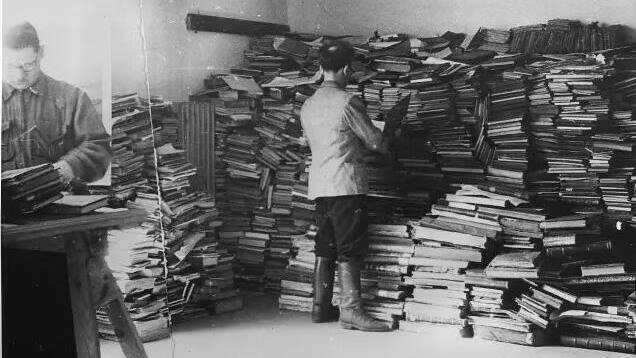
Also the Germans ordered to burn books. “Every printing in Hebrew letters had to vanish. Some of them we indeed burn”, but the Judenrat managed to hide books and writings inside walls of houses and rescued mainly religious books. This action to save Jewish books parallels the story of the “Paper Brigade” in the Vilna ghetto.[16]
Despite the Judenrat’s efforts to save the Jewish population in the ghetto, the people did not fully trust them and did not always follow their orders. According to Deul, who was part of the Judenrat, this risked the ghetto and made their job even harder. When the Germans requested handing over people, the Judenrat usually tried not to separate families. In a couple of instances, when they had to choose people to be deported – “we set all night to list the people. How not to take the last son from the house, and not to take from the family its provider… we were careful not to take children from their mothers” (Deul’s diary, D.2.8). Such were the Judenrat tough choices.
In sum, the importance of this diary lies mainly in the “small” anecdotes the writer tells on the maltreatment of the Jews, their daily humiliation, and the absurdity of life. Thus, it unfolds the inner picture of what Jews had to endure in the Oszmiana ghetto.
What is apparent in the diary is the lack of order in the ghetto. Instructions were unclear, and Jews were living in uncertainty. For example, there was no medical doctor in the ghetto, and it was difficult to consult on medical issues. Moral dilemmas are also described in the diary. The Judenrat tried to save Jews by tricking the Germans. But since they had to keep it secret, the Jews accused them of not assisting them.
The Aktion in Oszmiana, October 1942
One of the most important descriptions in Deul’s diary is the event that became known in the historiography as the “Aktion in Oszmiana”. In October 1942, the Germans demanded to reduce the number of residents in that crowded place, and the Vilna ghetto’s head of the Judenrat, Yaacov Gens, and its head of the Jewish Police, David Salek Dessler, took upon themselves to deliver to the Germans hundreds of Oszmiana ghetto inmates. After intense negotiation with Martin Weiss, who initially demanded the delivery of 1,500 people, the number dropped to 600 and finally to 406. Gens and Dessler suggested giving away the elderly and the sick to save the young and the strong. This controversial event is described in Deul’s diary from within since the local Judenrat was secretly involved in the discussion and informed by Dessler about what would happen. And indeed, a group of Vilna ghetto policemen conducted the Aktion themselves, according to a plan.
Deul was involved in the operation and, naturally, defended the Jewish leadership’s decision to take it upon itself. She writes that it was apparent to everyone that had the Aktion been conducted by non-Jewish perpetrators, it would have been much worse. “The blood price was paid”, she wrote afterward; 406 people were taken out of town to a field in Ogliovo (near Tolminovo). There they were brought in groups to a large pit and shot dead by Lithuanian collaborators. Stefania L. was fourteen years old at the time. She was ordered to drive her father’s cart to upload Jews from the ghetto and bring them to the killing site. She remembers that the Jews who were uploaded to her cart had bags and bundles with them, but she was too scared to look back. She took the Jews to Ogliovo and unloaded them and their belongings in a barn (Stefania L., 2014).
In the evening, the Lithuanians returned to the ghetto drunk and returned the blood-covered shovels they borrowed. Deul writes that near the killing site, there was a phone station where some Jews worked. Two young workers there, who knew that their fathers are among the victims, wanted to save them. They went to Ogliovo to try and sneak to the killing site to find their fathers but were seen by Weiss himself, caught and killed as well. After describing this event, Deul adds an interesting note: “This is a purely psychological phenomenon – that after bloodshed there is a stronger willingness to live in the ghetto. The ghetto began to rehabilitate itself”. Indeed, in a short time, the ghetto recovered, so to speak; it assumed the character of a well-organized small town, and living conditions improved. The survivors of the Aktion worked and produced, and food was better – there was no hunger. The Judenrat moved to the building of the former school. A clinic for the sick and a dental clinic were opened. A small hospital, school, library, club, and a public bathhouse were established. The most impressive facilities in the ghetto, according to Deul, were the workshops in which Jews worked and produced boots. The new “good” and “normal” life lasted for five months, from November 1942 till the end of March 1943 (Deul’s diary, D.2.8).
When spring came, “we received an official announcement: the Oszmiana ghetto will be liquidated”. There were 2,880 people in the ghetto at the time. The liquidation operation was once again conducted by the Judenrat of Vilna ghetto, at the command of Gens, assisted by the Vilna Jewish Police. Gens arrived at Oszmiana and delivered a calming speech, but the days were difficult, as people knew that such an Aktion could not be fulfilled without bloodshed. According to Deul, on April 28, the Judenrat members were the last to be deported to Vilna, and she was probably among them. The ghetto of Oszmiana ceased to exist.
The diary ends with a description of the Aktion of liquidation of the other small ghettos in the Vilna district, including Oszmiana. Most of their inmates were murdered in the Ponary death site. “Some people survived. They tell horrific things. The belongings of the murdered collected in the train cars and from the slaughter field were brought to Vilna. The best items stayed at [the possession] of the Gestapo. The worst were sent to the ghetto. On the parcels, we read the family names of acquaintances” (Deul’s diary, D.2.8). These are the last words in Hinda Deul’s diary.
During this final Aktion in Oszmiana, about twenty Jews escaped to the nearby forests and joined Soviet partisan units. In the ghetto, beforehand, a group of young Jews started deliberating on escape options and seeking help from local acquaintances to move eastwards. When the ghetto was liquidated, instead of going to the train station where the Jews were gathering, the group went towards the Jewish cemetery and continued escaping to the east. They had no water and drank snow.[17]
Among the survivors of the Holocaust, we can find conflicted attitudes towards the Judenrat’s actions. Nissan Reznik, for example, a survivor of the Vilna ghetto (who was a member of the headquarter of the FPO underground, escaped to the Narocz forests, and joined the Soviet partisan units), recalled in his testimony:
“What I denounce in Gens’ behavior is that he took upon himself the role of the ghetto commander at the service of the Germans. He had many Christian friends; he could have easily stayed outside of the ghetto and live in a safe place. His wife came to visit him in the ghetto once a month. She used to beg him to get out of there and join her. Gens refused. ‘I belong in the ghetto’, he used to say. Maybe he was drawn to the role of the commander. Maybe he loved the authority, the uniforms, the ranks, the power. In this job, there was a lot of power, almost an Absolut power to determine the fates of life and death… but maybe he referred to his job as a mission and believed that under the existing circumstances collaborating with the Germans is the lesser of two evils, and someone needs to do the dirty work, and he took that responsibility” (Reznik, Ghetto Fighters House Archive, 14318).
Bibliography
Unpublished Material
Diary of Hinda Deul, Moreshet Archive, D.2.8.
Testimony of Marian Z., Yahad in Unum Project, Eyewitness N°714, interviewed on April 20, 2014.
Testimony of Stefania L., Yahad In Unum Project, Witness N°718, interviewed on April 21, 2014.
Testimony of Aharon Dolinski, Yad Vashem Archive, O3-5053.
Testimony of Nissan Reznik, “This is how it was during those days”, Ghetto Fighters House Archive, 14318.
Testimony of Aharon Leibman, Yad Vashem Archive, O33-7218.
Published Material
Arad, Y. Jewish Vilna in Struggle and Destruction. Tel-Aviv, Yad Vashem and Tel‑Aviv University, 1976.
Baumel-Schwartz, J. and Ofer, D. (eds.) Her Story, My Story? Writing About Women and the Holocaust. Bern: Peter Lang, 2020.
Fishman, D. E. The Book Smugglers. Lebanon, NH, ForeEdge, 2017.
Gilbert, M. (ed.). Oszmana Memorial Book, publ. by the Oszmaner Organization in Israel and the Oszmaner Society in the USA. Tel Aviv, 1969.
Goldberg, A. Holocaust Diaries as “Life Stories”. Jerusalem: Yad Vashem, 2004.
Grossmann, A. “Holocaust Studies in Our Age of Catastrophe [in:] The Journal of Holocaust Research, 35:2, 2021.
Kassow, S. Who will write our history? Emanuel Ringelblum, the Warsaw Ghetto and the Oyneg Shabes Archive. Bloomington and Indianapolis: Indiana University Press, 2007.
Levi, P. The Drowned and the Saved. New York, Vintage Books, 1989.
Ofer, D. and Weitzman, L. The Role of Gender in Holocaust Research [in:] Moreshet Journal 67, 1999, 9-24.
Soltz, Hosea. The History of Oshmana [in:] Gelbert, M. (ed.). Oshmana Memorial Book, Tel‑Aviv, Oshmana Organization in Israel, and the Oshmana Society in the USA, 1969, 13-15.
Soltz, Moshe. Memories from Oszmiana [in:] Gelbert, M. (ed.). Oshmana Memorial Book, Tel-Aviv, Oshmana Organization in Israel, and the Oshmana Society in the USA, 1969, 322-330.
Spector, Shmuel (ed.). Pinkas Hakehilot – Encyclopedia of Jewish Communities in Poland: Vol. VIII, Jerusalem: Yad Vashem, 2005.
[1] On women during the Holocaust see for example Judith Baumel-Schwartz and Dalia Ofer (Eds.), Her Story, My Story? Writing About Women and the Holocaust (Bern: Peter Lang, 2020); Dalia Ofer and Lenore Weitzman, “The Role of Gender in Holocaust Research”, Moreshet Journal 67 (1999), pp. 9-24.
[2] In Polish, Cecylia Słapakowa. Her original writings from Emanuel Ringelblum’s archive are in The Jewish Historical Institute, ARG I 597.
[3] On Oszmiana before and during The Second World War, see Shmuel Spector (Ed.). Pinkas Hakehilot – Encyclopedia of Jewish Communities in Poland, Vol. VIII (Jerusalem: Yad Vashem, 2005), pp. 107-114.
[4] Diary of Hinda Deul, Moreshet Archive, D.2.8.
[5] M. Gilbert (Ed.), Oszmana Memorial Book, published by the Oszmaner Organization in Israel and the Oszmaner Society in the USA (Tel Aviv, 1969). The Hebrew translation of the diary is in pages 297-321, and the English segments in pages 59-73.
[6] The Aktion in Oszmiana was described among others in Yitzchak Arad, Jewish Vilna in Struggle and Destruction (Tel-Aviv, Yad Vashem and Tel-Aviv University, 1976), p.15; See the English edition: Ghetto in Flames: The Struggle and Destruction of the Jews in Vilna in the Holocaust (New York, Ktav, 1980).
[7] The Germans set-up a camp in Mielegjany in April 1942 and deported to it Jewish workers from Oszmiana, Vidz and Michaliszki. The Jews had to pave roads. The hunger, crowdedness and lack of sanitation caused the eruption of Typhus epidemic in the camp. In March 1943, the camp was liquidated, and the remaining workers were distributed to other camps. Spector (Ed.). Pinkas Hakehilot, pp. 413-414.
[8] See her page in The Central Database of Shoah Victims’ Names at Yad Vashem. An acquaintance of her writes that Deul found her death in this camp in 1944.
[9] FPO – Fareynikte Partizaner Organizatsye (Yiddish, “United Partisan Organization”) was formed in January 1942 in the Vilna ghetto by youth movement members with a purpose of resisting the Nazis.
[10] On the incredible story of rescuing Jewish books and writings from the Vilna ghetto by “The Paper Brigade” see David E. Fishman’s book, The Book Smugglers (Lebanon, NH, ForeEdge, 2017).
[11] For example, see Katarzyna Person’s book on the role of the Jewish police in the Warsaw ghetto, and Talia Farkash’s study on Jewish police and Judenrat in Tarnów ghetto. See Katarzyna Person, Warsaw Ghetto Police: The Jewish Order Service During the Nazi Occupation (Ithaca and London: Cornell University Press, 2021), and Talia Farkash, The Jews of Tarnów in World War II and the Holocaust, 1939-1944 (Haifa University Dissertation, 2020). On the Judenrats see Dan Michman, “Jewish Leadership in Extremis”, in Dan Stone (Ed.), The Historiography of the Holocaust (Basingstoke: Palgrave Macmillan, 2005), pp. 319-340.
[12] Rabbi Heller is an interesting character, although not much is known about him. At the recommendation of the wealthiest Jew in town named Strugach, a rather young Rabbi from the town Ostrowiec (Astravyets), located about 24 kilometers north, was chosen to be the religious leader of Oszmianan. Heller was a tall man with a nice face and a short beard. He was charismatic and captivated his listeners. He was a modern man who was naturally familiar with the Jewish religion and also had a broad general knowledge.
[13] Deul uses the Polish words “Cyganów”, or “Cygan”.
[14] On the fate of Roma people in this area see Volha Bartash, “The Romani Family before and during the Holocaust”, in Eliyana R. Adler and Katerina Capková (Eds.), Jewish and Romani Families in the Holocaust and its Aftermath (Rutgers University Press, 2021), pp. 17-41.
[15] Ponary (Paneriai) was the main mass murder site of the Vilna Jews. It is located about 11 kilometers south-east of Vilnius and between July 1941-July 1944 about 70,000 people were murdered there by shootings into large pit holes. The victims were mostly Jewish, but also Poles who were anti-Nazis, Soviet Prisoners of War, Lithuanian priests, and Roma.
[16]See David Fishman, The Book Smugglers.
[17] See the testimony of Aharon Dolinski, Yad Vashem Archive, O3-5053.