The study of the Holocaust has traditionally focused heavily on armed resistance and the horrors of Nazi concentration camps, frequently leaving the subject of forced labor camps under-researched. Yet, working in forced labor camps constituted one of the primary paths of survival for Jews during this dark era. Through extensive archival resources, the deeply harrowing and complex realities of these camps come to light through rare first-hand testimonies, artwork, and personal diaries.
A powerful example of visual documentation from these camps is found in the life and artwork of Szmul Leitner. Born in Będzin, Poland, in 1925, Leitner was abducted as a teenager and survived the ordeal of being shuffled through seven different forced labor camps before being liberated by the U.S. Army on May 2, 1945. Leitner visually recorded his experiences through a series of precise, striking drawings executed in black marker—often on brown packing paper reminiscent of the cement sacks he handled in the camps. Although most of his original wartime sketches were lost or later destroyed by the British in a Cyprus displaced persons camp, Leitner painstakingly recreated them in the 1950s. His artwork serves as a legal-like exhibit documenting camp infrastructure, the inspection yards, soup lines, public executions, and even everyday details like ration items and improvised musical instruments. For Leitner, drawing acted as both an inner compulsion and a psychological refuge from the brutal day-to-day realities of camp life. Today, such survivor artwork stands as an invaluable educational tool, bridging the gap for younger generations who often connect more easily with visual imagery than written text.
The archives also preserve personal testimonies from forced labor survivors, including Avraham Vered and Henya Kalsky (Vered). Avraham Vered, born in Bialystok in 1925, was sent from Majdanek to the S.S.-administered labor camp at Bliżyn in July 1944. In Bliżyn, inmates worked twelve-hour shifts sewing Wehrmacht uniforms amidst abysmal living conditions, severe overcrowding, meager rations, and rampant typhus. Vered’s survival hinged on mutual protection agreements with a friend to fight off corpse collectors who routinely preyed on the sick and dying.
Henya Kalsky’s journey highlights the multifaceted and dehumanizing nature of the camp system. Deported from Lodz to Auschwitz-Birkenau, she survived horrific medical experiments that left her infertile. She was subsequently transferred via Bergen-Belsen to a subterranean forced labor camp near Braunschweig, Germany, where over a thousand women labored beneath the earth manufacturing bullets for Mauser rifles. Guarded by SS personnel, the women faced grueling 15-hour shifts where sitting down was treated as punishable sabotage. Amidst this despair, unexpected flickers of humanity occasionally emerged, such as an elderly German mechanic who covertly provided Kalsky with moments of rest, a needle and thread, and hidden scraps of bread.
These recovered testimonies and artifacts demonstrate that survival in the forced labor camps followed no single template. Inmates endured constant terror and subhuman conditions, driven forward by sheer inertia, internal compulsion, human solidarity, and a blind twist of fate.
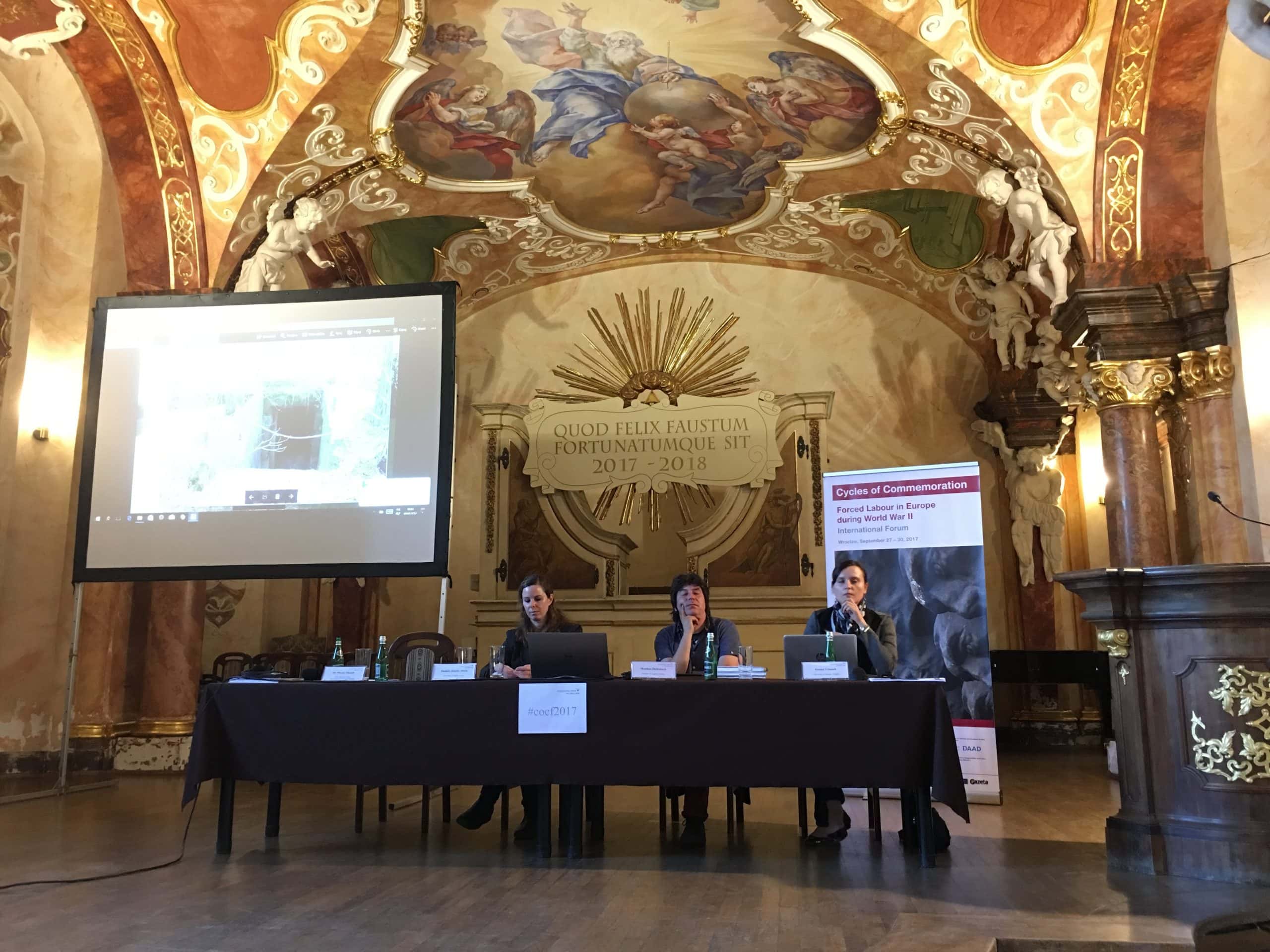
The full lecture was delivered at the “Cycles of Commemoration: Forced Labor in Europe during World War II” conference, held in Wrocław from September 27–30, 2017.