Testimony from the Moreshet Archive: Jacob Spira, a medical doctor in Nováky forced labor camp
Daniela Ozacky Stern[1]
Introduction: The Holocaust in Slovakia
In the second half of the 1930s with the enhancement of political tensions in Czechoslovakia, anti-Semitic tendencies increased among large parts of the Slovak people. Nationalist parties, like the Hilinka Slovak People’s Party (HSLS), which sought national autonomy, adopted extreme anti-Semitic stands, and inflamed the people against the Jews. After the Munich Agreement, at the end of September 1938, which forced Czechoslovakia to give up lands to the Third Reich, the Slovak People’s Party announced on October 6, 1938 a vast autonomy to the Slovakian region and established a totalitarian and single-party regime, headed by the extreme anti-Semitic party with Dr. Jozef Tiso as prime minister and later president.[2] On November 2, vast parts of land in south Slovakia, where more than 45,000 Jews lived, were appended to Hungary. The Slovak government pointed to the assessment that the Jews supported the Hungarians and started to expel thousands of Jewish families who had foreign citizenships to the Hungarian and Polish borders. The total population of Jews who remained in Slovakia before WWII was approximately 89,000.
After the establishment of the Slovakian state as a protectorate of Germany, on March 14, 1939, the Slovak parliament started to legislate laws against the Jewish population, at the example of
the Nazi laws.[3] The aim was to drive the Jews from financial life and plunder their possessions. In 1940 an SS officer, Dieter Wisliceny, one of Adolf Eichmann’s subordinates, was sent to Slovakia in order to speed up the “Final Solution of the Jewish Question” there.[4] In September 1940, the Slovakian authorities ordered to erect a Judenrat called “The Center of Jews”,[5] as the only authority to represent the Jews and organize Jewish life in the country. The anti-Jewish legal system became more extreme in September 1941 and was known as “The Jewish Codex”. A “Jew” was determined as a racial principal and the Jewish population was forced to wear yellow star on the clothes. With the Codex being published, the final preparations were set for the next step – the deportation of Jews to death camps. Plans for the deportations of the Slovakian Jews were probably consulted among the Slovak regime and the Germans at the end of January 1942. First to be deported were 6,720 Jews from Bratislava to the provincial towns, and simultaneously thousands of Jews were sent to forced labor duties. Many Jewish families needed financial support from the Jewish Center, after losing their jobs and possessions.
Slovakian Jews were among the first to be deported to death camps I Poland. Starting from March 25,1942 until October 2, that year 57 transports with over 59,000 Jews left Slovakia. 38 deportation trains carrying over 40,000 Jews were transferred to Lublin District in Poland, and 19 transports with 18,600 Jews were sent to Auschwitz death camp.[6] Only about 19,000 Jews remained in Slovakia. They were considered “qualified” workers and held Certificates of Exemption. Additionally, about 3,500 Jews were detained in three forced labor camps in Slovakia: Nováky, Vyhne and Sered.[7] Approximately 10,000 Jews survived after fleeing to Hungary.
The Novàky forced Labor Camp
Nováky was at the beginning both a concentration and labor camp. As early as 1941 Jews were brought there to be sent to extermination in Poland. Between March and June 1942 about 3,000 men and women were deported from there to Majdanek and Sobibor. Later, the “Jewish Center” negotiated with the Ministry of Interior arguing that there are professionals among the Jews who might help the Slovak economy and it is better to keep them in labor camps where they can work, and not to send them away. So indeed, Nováky became a forced labor camp but after the last deportation left it on September 23, 1941, which happened to be the Jewish Holy Day of Atonement, Yom Kippur.[8]
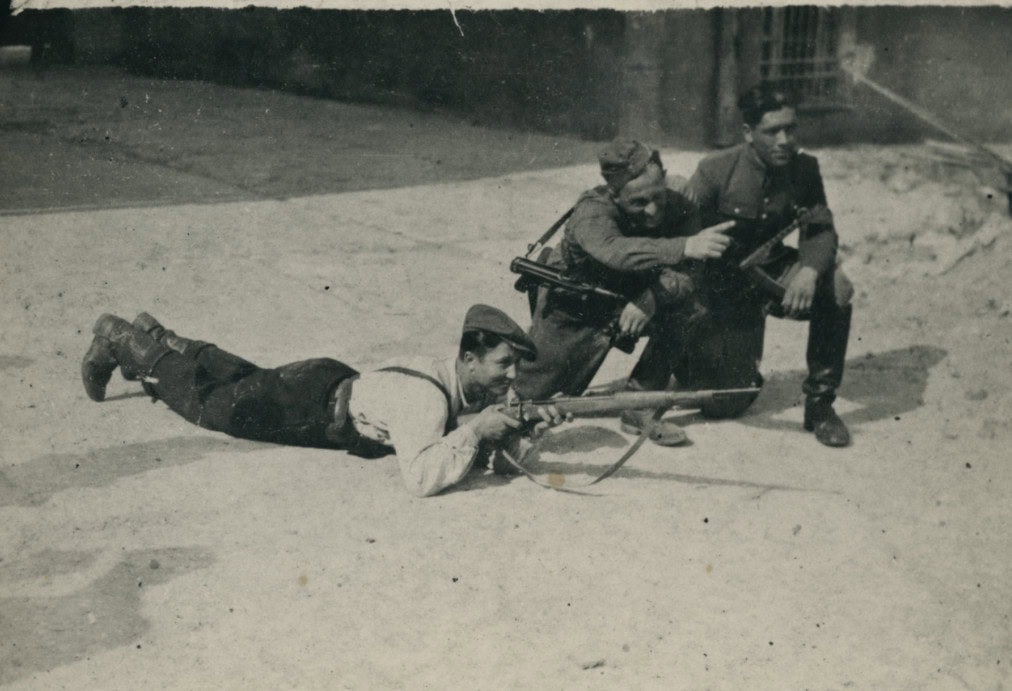
Life in the camp was harsh. Inmates from 14 years old and up were required to work ten hours a day, they lived in crowded barracks and the food was meager. Strict discipline was imposed on them and they were punished for every small disobedience. A council of 11 Jews headed by engineer Otto Mendler was responsible for running the social and daily life in the camp. 1,600 people who were detained in Nováky after the deportations managed to produce goods for the army, the police and for the Hlinka guard, and the camp was considered economically productive.[9] An underground was formed in Nováky by young Jews who collected arms and trained themselves to resist when the right moment comes. Their number is estimated to be 200 members, most of them indeed joined the rebels in August 1944 when the camp was liberated during the Slovak National Uprising.
Jews in the Slovak Resistance
The Slovak National Uprising took place between August 28 and October 27, 1944. A coalition of several opposition groups was formed with the aim of expelling the government led by HSLS and liberate Slovakia from the German grip. Yeshayahu Jelinek who investigated the role of Jews in the national uprising claims that: “Jews took a certain, though not large part in the instigation and development of the Slovak National Uprising… they joined both voluntarily and through conscription”.[10]
Partisan groups were assembled in the forests by opponents to the government as early as 1942 and Jews who were looking for ways to escape the deportations joined them. The initial contacts were made by communist Jews who were members of the Slovak National Council, who understood that joining the rebels could be a lifesaving act for them. About 2,000 Jews took part in the uprising and in addition 1,566 Jews joined the partisans and constituted about 10% of the entire partisan movement in Slovakia. The 205 underground members of Nováky fought as a separated unit, first within the army and later as partisans.[11] Four parachutists, among them Haviva Reik, who were sent from Palestine by the British Intelligence and the Jewish Agency arrived at Slovakia in order to support the resistance against the Germans and recruit young Jews to fight, but only one of them survived.[12]
The Testimonies Collection in the Moreshet Archive
The Moreshet Archive is part of the The Mordechai Anielevich Memorial Holocaust Studies and Research Center located at Givat Haviva, Israel. Moreshet was established in 1961 by a group of Holocaust survivors who were ghetto fighters and partisans during the Second World War. The Moreshet Archive has collected and preserved original documents, photographs, and different types of memorabilia from the Holocaust and the war. It holds a vast collection of personal and collective testimonies, written and recorded, assembled immediately after liberation and during the decades that followed. The archive holds hundreds of audio cassettes of Holocaust survivors telling their stories in their own words. Many of these testimonies have not yet been published. A large video collection, including documentary and feature films about the Holocaust; filmed testimonies of survivors and more are also preserved at Moreshet.
There is a special section of testimonies of Holocaust survivors from Slovakia and rich material on their life during the war and the role of Jews in the Slovak National Uprising. Givat Haviva (“Haviva’s Hill” in Hebrew) is called after Haviva Reik who was born in Banská Bystrica, Slovakia in 1914, immigrated to Israel in 1939 and was a member of Kibbutz Ma’anit. In 1944 she was sent as part of a group of 33 parachutists to their home countries in Europe on military missions to organize local Jews to resist the Nazi occupation. Reik and four others were dropped in Slovakia. After six weeks of working among the Jews around Banská Bystrica she was murdered by the Germans in Kremnička with a group of 250 Jews who were buried in a mass grave. Her letters, certificates and photos are preserved in Moreshet Archive as well.
Not far from Givat Haviva, a group of Slovakian survivors founded a kibbutz in 1949 and called it after Haviva Reik – Lehavot Haviva (Haviva’s flames). Among them there were people with historical awareness who started collecting testimonies, documents and artifacts and write books and papers on the period of the war. It so happened that most of this material was given to Moreshet Archive and is part of the Slovak collection. Additional documentation from Slovakia was later collected by the late Yehoshua (Robino) Büchler, one of the founders of Kibbutz Lehavot Haviva and a long-time director of Moreshet Archive. Büchler (1929-2009) a survivor of Auschwitz and Buchenwald, was a leading researcher himself and thanks to him and others among them Yeshayahu Jelinek and Akiva Nir we have a vast body of documentation about the Holocaust in Slovakia.
Dr. Jacob Spira (Jakub Ŝpiro) A medical doctor at Nováky camp
Out of this collection I chose to present here one testimony that to the best of my knowledge has not been published nor translated to English or to Slovakian. It is the story of Dr. Jacob Spira, the chief physician in Nováky forced labor camp, who played a major role in the welfare and survival of its Jewish inmates and yet is not well known.
Dr. Spira was born in 1900 in Vranov nad Toplou and later moved with his family to Levoca. He graduated his medical studies in 1925 in Prague, did one year of internship in Vienna and started working as a physician in Nováky village thereafter. Spira, who served in the army in 1918 at the end of the WWI, was recruited again to the Slovak army in 1939 but was forced to resign shortly, due to the anti-Jewish legislation of 1940. Since November 1941 he had served as a physician in Nováky forced labor camp, where he was imprisoned with his wife and two children and was witness to the first transportations of Jews to Auschwitz. When the Slovak uprising had started and the camp was liberated, he joined the partisans in Banská Bystrica and survived with his family, his wife Anna and his children Vera and Thomas (Tomy).
Spira was a highly appreciated physician in the camp and stood up for his patients and the entire population in front of the camp authorities. He demanded that the inmates get permission and facilities for sport activities, and even succeeded to persuade the commanders to build a swimming-pool in the camp. At one point, Dr. Spira protested the quality and quantity of the food which was provided to the workers. He wrote a cheeky letter to the commander and declared that workers should get better food, richer with proteins, in order to fulfill their duties, and indeed succeeded in his struggle.[13] At another time he strongly refused to let go of hospitalized Jews whom the authorities wanted to transport to a concentration camp in Poland and thus saved their life.
Juraj Spitzer, a Slovak author who was a prisoner in Nováky remembered this incident and wrote in his memoire fifty years later about the extraordinary dialogue between Spira and the commander:
“When the autumn transport was ready to leave, camp commander Nicholas Polhora ordered the physician Dr. Spira to put older people in the transport – patients from the camp hospital. ‘I will not give my consent, not in a single case’, said Spira, his voice raised. Polhora became angry. ‘You want young and healthy people to leave instead?’, ‘I don’t want anything; I did not invent the transport; if I give my consent, I might as well kill them here’. Polhora lost his composure: ‘So you shall leave too, go packing together with your family!’. He did not say a word, turned around and headed for his barrack. Polhora changed his order, he capitulated before this feisty little country doctor. The patients in the camp hospital were rescued”.[14]
A film about Nováky camp was made in 2017 by Lubo and Monika Stacho, who interviewed former prisoners of the camp and exposed many original photos demonstrating the daily life there. The interviewees talked highly about Dr. Spira and said that “he was a source of moral strength” and supported them in those difficult times. “Dr. Spira, an excellent camp physician was not only providing medical treatment but tried to implement regular sport activities for prisoners”, said Josef Weiss to the camera.[15]
The film is dedicated to Spira and to two other Jewish figures who played a major role in saving the camp workers from death: Otto Mandler who was the head of the Jewish council and Architect Andrej Steiner who oversaw the building of the barracks. The film directors claim that “the Slovak history has not yet recognized these personalities”.[16]
An important task of Dr. Spira was to prevent any infectious disease within the camp from endangering the surrounding population. As his son Dan wrote in his memoires 50 years later:
“This was 1942, only 25 years after WWI, with its epidemics that swept through Europe and the world. There were 3-4 other physicians in the camp, and indeed they succeeded in preventing any major outbreak of disease.”[17]
The following testimony was given in Hebrew by Dr. Jaacov Spira at his home in Kadima, Israel, in August 8, 1961 to Yeshayahu Jelinek, a Slovak born historian and author of many works on the Holocaust and the uprising in Slovakia. Jelinek collected at the time numerous testimonies from former Slovak Jews who survived the war, under the title: “Anti-Fascist Jewish resistance in Slovakia” and wrote several books and papers on this issue.
Spira’s testimony is open and candid, sometimes critical of himself and his fellow Jews, sometimes full of compassion. He supplies details on the daily life in the camp and on his experience among the partisans.
Following are excerpts from his testimony translated from Hebrew.[18]
The Testimony of Jacob Spira
The changes in my life began in 1938. Besides the other agitations which followed Hitlerism in 1933, which eventually brought some anti-Semitic attitudes in Slovakia, we still had normal life which could be even good in Novàky village, where I was the only doctor. In the last years [before the war] this village was important. A big factory for military chemical industry was built there, and not far away there was also a factory for heavy military industry, built deep in the ground, where about 4,000 people worked. Nearby there was a big military base. The officers there were mostly Czech. Those developments brough to personal changes in my life, as the village grew and I had more work to do, and this gave me more significance. In Slovakia, as a country with many minorities, we did not think that something bad could happen between the different nationalities, including the Jews.
The first change came after the war broke with Poland in 1939. I was a military doctor and so was deployed as MD in Košice and then in Liptovský Mikuláš as part of a medical staff. One day, an order came to leave for the front. That evening we already heard that there were many changes and that we were in fact not going to the front but rather to a Slovak Nazi army. That evening I also heard anti-Jewish shouting like: “So Sidorom proti Židom”[19] and similar slogans. The next morning, I went home without telling anyone and without permission. Not much longer afterwards more personal changes began in my privet life. I stayed at my job until the issue of the law in the summer of 1940, which laid off all Jewish doctors from their place of work and took their license. A Slovak doctor came and took my job, and I had to leave Novàky. So I stopped being a doctor and went to work in the Chemical factory in Novàky, as medical assistant until a governmental delegate came to check the place, and when they found out I was a Jew they fired me. Then I had nothing more to do in the village, and we went to Nitra, where my wife’s parents lived. There, after a short while Jews started to work in labor camps, and I became a foreign doctor in Nitra for a working group. I worked there until 1941, when I got a warning from the interior ministry, the 14 division that dealt with Jews, that I must go back to Nováky. In there a big camp for Jews in being built and I would be the medical doctor there. And so, my life as the camp doctor began.
I arrived at the camp on November 5, 1941. The first transport was deported on March 31, 1942.[20] Many young people, men, were told that they are sent to Poland to work, because villages and camps for Jews will be established there. Even though it was very tragic, I must say that I believed, everyone believed, that they are truly pioneers for work, that they want to send to Poland the Jews who are not wanted in Slovakia. One doctor also went. Just a day before he was brought to the camp from some village, he was a communist, and this doctor went with the first transport of about 300 Jews… that time the camp was not ready yet, the barracks were only begun to be built. And we were there only the workers who constructed the roads, who built the barracks, and built this camp for Jews. Not only the workers but also their families. Afterwards, Jews started coming in masses… Nováky camp was divided into three parts: in the first one they built barracks for thousands of Jews with beds of 3-4 floors. The workers did not understand why they need to build it so fast, in an unhuman way. The chief engineer knew that the aim was to concentrate thousands of Jews there, to be sent to Auschwitz. It was May or June when they brought 4-6 thousand Jews from the area, put them in the barracks for a few days and sent them to Auschwitz.
Work as a mean to survival
At that moment I started the first attempt to save Jews. We convinced the commander that there are some professional people among them who can be of use to the country. Indeed, we got permission to choose out of the 6,000 who were about to be sent to Poland, a few hundreds who had skills like carpenters and tailors to stay in the camp, while the others were taken away. At that time, I had not heard the name Auschwitz and had no idea where it was in Poland. I do not think anyone was able to escape from there. Like in every camp we had a local Jewish leadership who ran the internal affairs of the Jews. Chairperson was Dr. Mendler. The camp commander was Polhora who was a medical student, an intelligent person who was sensitive to medical issues and at first was supportive a little to my work, until something happened in 1942 before Yom Kippur (Jewish Atonement Day). A baby was born in Nováky and I brought a mohel (circumciser) to perform the circumcision, and there was a big celebration. The guards[21] told the commander about this, blamed me for conducting this feast and demanded that I would be kicked out from my position as a doctor. I was sent to work in the quarry. The physician who replaced me Dr. Kerte could not do the job, he broke down, so the Jewish leadership demanded that I be put back to work. Sometimes I used my position to send Jews out from the camp by providing them medical reference to a nearby hospital for consultation. This way I also helped the underground.
Daily life in the camp
Our situation was better than in the camps in Poland. We had enough food and good medical care – seven doctors for 1,600 Jewish inmates. Also, we had a relatively proper relationships with the camp commander, using also bribe and paying a lot of money. During the 36 months we stayed there, from November 1941 till August 1944, there were 22 births and only 7 deaths, even though it was a concentration camp. There were also many abortions. Any woman who wanted it – could have it by us or I would send her to a doctor outside the camp. There were two cases I remember of people who tried to escape and were beaten to death. All kinds of diseases had developed due to the harsh conditions, like Thyroid toxicity and of course traumas and depression. I do not remember psychosis apart from the one doctor.
Beatings were a daily routine. I remember Leibovitz, a shohet (slaughterer) from Prievidza, who refused to shave his beard and both him and the barber who did not shave him were hardly beaten. Another man who did not salute the guards was also beaten hard, women who were caught with money or gold, and many more.
We were not free of course but tried to maintain cultural life. There was a choir and a small theater, school with good authorized Jewish teachers, kindergarten, books, and toys which we got as a donation from outside the camp. Even a small swimming pool for the kids was built by our builders and a big kitchen which provided food.
There were 34 workshops which produced goods in addition to construction which was a hard work done in primitive means and the quarry.
After the war I realized that our situation was better than in the camps in Poland and Germany and even better than Terezin.
We had lived like this till August 28, 1944, when the Germans entered Slovakia. Until than I was terribly busy as a doctor in the camp and did also administrative work. I was the only one who could send patients to hospitals outside the camp. Our hospital was in Sered. I used my position also to send away people who were not sick, who were part of the underground. I was aware of their position and realized it after August 28, when there was already a connection between them and the partisan army in Zemianske Kostoľany. A few days later those whom I released joined the battle of Baťovany.[22] I was ordered to stay in the camp and to take care of the wounded of this battle – Jews and non-Jews.
With the partisans
One day after the German-Slovakian army arrived at the area I left Nováky to Banská Bystrica and met friends who were in the partisans. One of their commanders nominated me to be a doctor in a mixed unit of partisans and soldiers which dissolved a few days later, and I remained with the partisans and took care of everyone there, including the inhabitants of the village of Kalište who helped the partisans. I remained there in a hospital in a bunker till the end of the war. It was Passover eve when we were liberated by the Romanian army. I went back to Novàky but was sick and stayed there till 1948. There was a committee that investigated my whereabouts during the war and when I told them that I was a doctor among the Jewish partisans they said that the Jews never volunteered to be partisans, they simply had no choice but to run away to the mountains and there they joined the partisans in order to fight the Germans. This was the first time I heard this version.
I heard about the anti-fascist underground that was also anti-Hlinka even before I came to the camp, before the war, because some of its members came from the village in which I served as a doctor. I do not think there were Jews among them at the time. In Novàky I learnt that there was an organized underground only after the first transport, on March 31, 1942. I heard that it had contacts with the partisans of the Hagara group[23] in the mountains of Vtáčnik and with members of the underground in Bratislava. Someone important told me that as a doctor I need to help them send out from the camp people who were not really sick, when they demand it. And indeed, I did it several times. I remember a case of a young woman, Edith Katz, who had a defect in her heart. She was a communist and a former prisoner, so the camp commander said that I cannot send her to a hospital. I asked around and was told that there were more Jews who were sent to prison due to communist activity and thus were saved from deportation to Poland. So, I tried to find for her easy jobs because she was not capable of physical work. A few days later the underground gave me an order to send her to a hospital outside, they said she must be out before a disaster happens to her, and I am the only one who can help. It took a while, the commander refused to let her go, so I took her into the clinic to take care of her and after a while told him that I cannot be responsible anymore and that she must be admitted to a hospital. Finally, she had left, and I had not heard about her until the uprising. 2-3 days after it broke out, I was in the mountains and saw Katz holding a machine gun, among a group of partisans who marched across the village…
There were more cases like this, that I helped the underground sending its people away, but I did not know much about the organization. I do not know if they had weapons in the camp. I heard rumors that they did, but I never saw it and cannot say if individuals had arms or if it belonged to the underground. What I do know is that a day after the uprising broke out – the young guys in the camp were armed. Everyone knew that there was an organization but, in the camp, it was best not to talk, certainly not about sensitive issues like this.
Among the Jews in the camp there were pessimists and optimists. Those who witnessed the three transports and were awaiting the next ones, and those who believed that we are about to go back to our normal life soon and will get everything back. I do not remember talks about resistance. In 1944 people were waiting to be freed and never anticipated freedom in the tragic form it took. For the Jews – despite the uprising, many of them were captured and sent to Auschwitz or were murdered on the spot. I myself opened big graves near Kostolné and found dead Jews who were murdered after the beginning of the uprising.
After the uprising
Many Jews who had left the camp after liberation came back soon after because they had nowhere to go, nobody let them in. I was in the camp until the last day, it was the army order and the commander was new, a military man. His name was Michael Cohen, later he was killed as a partisan in the fight against the Germans. Those who went West are not alive today, those who went East with us – most of them survived. We took the Jews to the center of the uprising in Banská Bystrica. We took all the sick and wounded as well. The order was to go to Banská Bystrica via Handlová, where there was a hospital with many patients. A few of them wanted to travel on with me and I took four – two remained in another hospital in Sliač and two continued with me. Most of the Jews who joined the partisans were in Banská Bystrica, I know that there were more in other places and others who did not want to abandon their families and stayed with them and did not join the partisans. I myself was a doctor at the partisan base in Baláže and when the first German attack happened on November 14th wanted to take my family with me to escape with the Russian brigade. They said I could not take the family, so I stayed with them and did not leave. But two days later the Russians came back, and I remained their medical doctor.
It was a festive day in the camp when the young men joined the army, but the day after was mournful since we heard that a few of the best boys fell in battle in Baťovany, so we realized, it was not a game, it is a serious matter. Parents found out about their sons who died right away. I was witness to the moment Dr. Helena Friedman received the announcement that her son fell in battle, but she never stopped her work, not for a moment.
At first, the Jews believed that it was a matter of a few days until the Russian army comes to support the rebels, but later, those who were in the mountains among the partisans realized that this was not the case. The Russian army was terribly slow, and it would be difficult to stand against the Slovak-German army with the primitive conditions we had. We saw how many partisans and Jews had died on November 14th, during the first German attack and that the Jews had suffered during the revolt more than in the camp. They suffered physically but not mentally. However, there were cases of improper attitude towards the Jews among the partisans. Even in the unit I served as a doctor one of the Slovak officers, his name was Kish, wanted to expel the Jews and I went to talk to the deputy commander – who was a Russian Jew named Kagan – and told him about this. Kagan spoke to his superior who said that this is a partisans’ territory and according to communist and Russian laws no one can expel any person from it, so we were saved. Kish died a day or two later in the first German attack on November 14th. However, the Russians did not like the Jews and thought that we did not want to fight but joined the partisans because we had no other choice. But everyone knew that there were brave Jewish fighters who held difficult roles in the units, and also that there were some professionals who helped in sabotaging railroad tracks. There were many more Jewish doctors in various units. I remember Dr. Brown who worked in a hospital located in a bunker in Baláže and another one who later became the head doctor of the Slovakian police.
When we first came as a group from Nováky to the partisans they considered us valuable, most Jews were cultured and educated, and they respected us. But when more and more non-Jews joined the partisans and we became a minority – a big one but still a minority – they started to find excuses against the Jews and complained about their functioning. They imposed on them more difficult tasks and sometimes behaved towards them not according to the law.
I heard about the parachutists who arrived from Eretz Israel (Palestine) but it came as a surprise for me that they did not join the organized brigade of Jegorov.[24] I do not know why they went to the mountains by themselves and not with a well-organized partisans’ group. I do not think they brought any added value. I think Haviva Reik was among them.
About the Jews who joined the partisans – part of them were invited to join – like myself and a pharmacist and two Slovak officers. A Russian commissar gave us political lectures and asked for our opinion about the future of Slovakia. But I also know that there were Jews among the partisans who hid their origin for fear of anti-Semitism among Russians and Slovaks alike. I think the Slovaks hated the Jews even more than the Russians, because they blamed them for communism and suspected that they wanted to destroy the Slovak state as it was in the time of Tiso. However, Jews played major roles among the partisans and there were high commanders who were Jewish.
When the Germans searched the partisans, they specifically were looking for Jews and killed them, while the non-Jewish partisans were imprisoned and not killed.
After the war when I asked to get a certificate approving that I was a partisan, the head of the committee said that Jews were not real partisans, they did not really volunteer to fight against fascism, but rather had no other choice if they wanted to save their life, and this was the only place for us to be.
Some Reflections
To conclude my story, I would like to add that I still find it hard to believe that 6,000 Jews who were taken to concentration camps from Novàky at the first period and 1,200 more later, went with no resistance and from their own will. Today, when I look back to those tragic days, I can still find it hard to believe and cannot explain this. I remember the first transport of 300 healthy young men marching in line to the train with only few guards around them. I think it was before the time of the organized underground. Maybe this was the reason. The same Jews who had built the barracks in the camp in a very short time, and erected the four story beds for thousands of people in hard work – when the time came, they went and did not even try to escape the lines. We did not rebel in the camp, when the Slovak uprising started it came to us from outside.
At that time, our behavior was different, it is hard to talk about it today. Our life was inhuman, and one cannot judge people’s behavior under those conditions. I will tell a personal story: When we escaped the Germans on November 14th, we were a group of eleven. I started walking and heard some calls: Stop! I lied down in the snow and heard shooting. Others who were standing under a tree and heard the shooting started yelling, the Germans shot to their direction and killed four of them. I knew that my wife and children were there and could not tell if they were among the dead. When the Germans left, I started searching and could not find them, all that time there were more shootings, and I heard the Germans shout: “Jews – step outside”. I was very tired and had some food I took for the family. I set under a tree in the snow and started eating the food. I cannot explain why I did this in the middle of the chaos. This is unhuman and unnatural, to eat the last food when you do not know what is going to happen to you in an hour or in a day. After I ate and went back to look for my family, I found them only twenty steps from where I was sitting. My wife and two children were there together.
So, what I am trying to say is that this was an unusual time that led to unusual thoughts and deeds. We were witnesses to ordinary people and to partisans, Jews, and non-Jews, who did things they would have never done under normal circumstances and regular times. And if I may add one more comment – there were among us optimists and pessimists. I would say that from the perspective of the Jews who came back [to Slovakia] – the pessimists were right.
Epilogue
Spira and his family emigrated to Israel in 1948 and he became a country doctor in a small community named Kadima in central Israel where he and his wife Anna. Their daughter Vera got married and lived in Tel Aviv and later emigrated to the USA. Their son who adopted a Hebrew name – Dan came to Israel before his parents and live in kibbutz Ma’anit, and later moved to Jerusalem to pursue academic studies. [25] Dr. Spira was much beloved by this community where he had lived and worked to the rest of his life. During the first years of his work there, he used to ride a small carriage pulled by a donkey and visit his patients at their homes. A nurse named Tova Freiman, a Holocaust survivor from Poland, worked closely with him and accompanied him also to delivering babies in the village and in the transit camp which was erected nearby, where Jewish newcomers from Yemen lived.[26] In one of this journeys he told Freiman about a traumatic experience he had in the camp. The wife of the German commander was in labor and had some complications. He was called as the chief camp physician to help, but her husband categorically refused to let a Jew examine his wife, despite her severe condition. The woman died while giving birth and Dr. Spira said that he was both alarmed and relieved. He knew that had he taken care of a German woman before her death, he would have been blamed for it and punished hard, maybe even executed.
In the early fifties they built a permanent clinic in Kadima and Dr. Spira had worked there until his late retirement. Everyone knew Dr. Spira in Kadima, he was kindhearted and treated all equally. After his death in 1982 a street in the village was named after him.[27]
Dr. Spira was one of many unknown and unrecognized heroes of the that dark time of war and Holocaust in Europe. His story is one of bravery and modesty, a physician and a humane person. Like others, he saw evil deeds and experienced horrors, but had the strength to recover and lead a life of caring and giving.
May this modest article be a small token of the commemoration he deserves.
List of References
Archival Sources
Moreshet Archive, Testimonies Collection (A.).
NIR, Akiva, “Labor Camps in Slovakia, 1942-1945”, Moreshet Archive, C.51.
Literature and Published Sources
BÜCHLER, Yehoshua Robert (ed.), The Book of Communities – Slovakia, Jerusalem: Yad Vashem, 2003, pp. 37-53.
GELBER, Yoav, “The mission of the Jewish Parachutists from Palestine in Europe in WWII“, Studies in Zionism 7, Spring 1986, pp. 51-76.
GUTMAN, Israel (ed.), Encyclopedia of the Holocaust (Vol. 4), Tel Aviv: Sifriat Hapoalim, 1990.
JELINEK, Yeshayahu, “The Role of the Jews in Slovakian Resistance”, Jahrbücher für Geschichte Osteuropas, Neue Folge, Bd. 15, H. 3, September 1967, pp. 415-422.
JELINEK, Yeshayahu, “Dr. Josef Tiso and His Biographers”, East Central Europe 6, 1979, pp. 76-84.
LIPSHER, Ladislav, “The role of Jews in the anti-fascist Defense War in Slovakia in WWII“, Moreshet Journal 14, April 1972, pp. 117-142.
ŜPITZER Juraj, I did not Want to be a Jew, Pittsburgh, Pennsylvania: Dorrance Publishing, 1997.
[1] Daniela Ozacky-Stern in the director of Moreshet Archive and a researcher of the Holocaust.
[2] JELINEK, Yeshayahu, “Dr. Josef Tiso and His Biographers”, East Central Europe 6, 1979, pp. 76-84.
[3] BÜCHLER, Yehoshua Robert (ed.), The Book of Communities – Slovakia, Jerusalem: Yad Vashem, 2003, pp. 37-53.
[4] Dieter Wisliceny was trialed after the war and was executed in Czechoslovakia in May 1948.
[5] Ustredn Zidovska Slovavensku Krajinu Pre Uradovna (ZUU).
[6] JELINEK, Yeshayahu, “The Role of the Jews in Slovakian Resistance”, Jahrbücher für Geschichte Osteuropas, Neue Folge, Bd. 15, H. 3, September 1967, pp. 415-422.
[7] NIR, Akiva, “Labor Camps in Slovakia, 1942-1945”, Moreshet Archive, C.51.
[8]GUTMAN, Israel (ed.), Encyclopedia of the Holocaust (Vol. 4), Tel Aviv: Sifriat Hapoalim, 1990, p. 806.
[9] Nir, Akiva, “Labor Camps in Slovakia”.
[10] JELINEK, “The Role of the Jews in Slovakian Resistance”, p. 418.
[11] Encyclopedia of the Holocaust (Vol. 3), p. 749; LIPSHER, Ladislav, “The role of Jews in the anti-fascist Defense War in Slovakia in WWII“, Moreshet Journal 14, April 1972, p. 137.
[12] GELBER, Yoav, “The mission of the Jewish Parachutists from Palestine in Europe in WWII“, Studies in Zionism 7, Spring 1986, pp. 51-76.
[13] Interview with Dr. Rami Spira, grandson, May 15, 2020.
[14]ŜPITZER Juraj, I did not Want to be a Jew, Pittsburgh, Pennsylvania: Dorrance Publishing, 1997, pp. 102-103.
[15] Zachor/Pamätaj/Remember, https://vimeo.com/259389347
[16] Ibid.
[17] Dan Spira memoire, unpublished manuscript. I am deeply grateful to Rami and Smadar Spira and to Tami Spira-Rahamimov for allowing me to read and to quote these fascinating memoires written by Prof. Dan Spira for the family and preserved in their home in Jerusalem.
[18]Translated and shortened by OZACKY-STERN, Daniela. I deleted the interviewer’s questions in order to keep the story flowing. The full testimony in Hebrew is available in Moreshet Archive, A.179.
[19] “With Sidor (name of the nationalist minister Karol Sidor) against Jews”.
[20] Nováky was both a concentration camp where Jews were detained before being sent to camps in Poland, and a forced labor camp for those who were professionals and were granted “immunity” as long as they worked.
[21] Members of Halinkova Garda (Hlinka Guard) – A Slovakian fascist party established in 1938 and had a major role in persecuting the Jews.
[22] In the battle of Baťovany members of the underground of Nováky joined the rebellious army and fought against the Germans who were sent to crush the resistance. 35 fighters were killed in this battle.
[23] The group named after its Slovak commander František Hagara.
[24] The brigade of Jegorov was led of the Soviet commander Alexej Semionovič Jegorov.
[25] His son Dan Spira became a parasitologist at the Hebrew University in Jerusalem, where he lives to this day. He has three children, eight grandchildren and three great-grandchildren. His son Rami is a medical doctor like his grandfather; His daughter Vera moved with her family from Israel to the USA in 1957, worked in a hospital and passed away in 2005 leaving two sons, five grandchildren and one great-grandson.
[26] An interview with Tova Freiman’s daughter Malka Haziz, May 7, 2020.
[27] An interview with current mayor of Kadima Mrs. Keren Green and a former mayor Yitzhak Golbari, May 6, 2020.
Published in:
Ozacky-Stern, D. (2019). Testimony from the Moreshet Archive: Jacob Spira, a Medical Doctor in Nováky Forced Labour Camp. Judaica et Holocaustica 10(2): 64-77.