This article by Dr. Daniela Ozacky-Stern explores the lived experiences of ordinary Jewish Holocaust survivors who participated in the Slovak resistance and partisan warfare during World War II. Based primarily on over thirty oral testimonies collected in Israel during the early 1960s by Yeshayahu Jelinek and Akiva Nir—which remained largely unused in the Moreshet Archive—the study adopts a micro-historical approach to examine bottom-up personal narratives.
Experiences of Jewish Fighters in the Slovak National Uprising and Partisan Resistance
Following the 1938 Munich Agreement and the establishment of a clerical fascist puppet state under Catholic priest Jozef Tiso, Slovakia became a willing satellite of Nazi Germany. It swiftly enacted anti-Jewish legislation, including the “Jewish Codex,” and established a centralized Jewish body, the Ústredna Židov (ÚŽ), which mirrored European Judenrats. Spurred by German demands, Slovakia became one of the first nations to deport its Jewish citizens, sending roughly 58,000 people to extermination camps like Auschwitz between March and October 1942. However, internal government conflicts and pressure from a clandestine Jewish “Working Group” led to a two-year hiatus in deportations. During this pause, approximately 3,500 Jews were concentrated into three forced labor camps—Nováky, Sered, and Vyhne—where young inmates, many from Zionist-Socialist youth movements like Hashomer Hatzair, formed underground networks. These groups procured weapons, established escape routes, forged protective documents, and trained for future armed resistance.
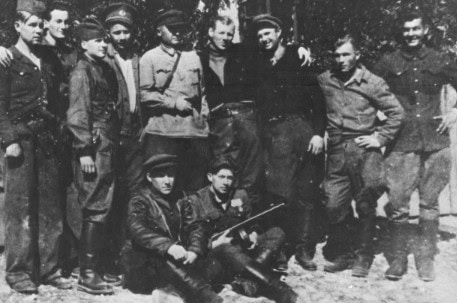
The situation dramatically shifted in late August 1944 when the Slovak National Uprising erupted against the totalitarian regime and invading German SS units. Rebels briefly controlled nearly half of the country, prompting thousands of camp inmates and hidden Jews to join the insurrection. Approximately 1,800 Slovak Jews actively participated in the resistance, fighting within rebel military units, constructing defenses, and aiding the anti-fascist cause. For these individuals, joining the uprising represented both a desperate bid for survival and a profound desire for revenge against their persecutors.
However, the uprising collapsed by late October 1944 under overwhelming German military force, sparking renewed mass deportations that ultimately claimed the lives of thousands more Slovak Jews. Survivors fled into the harsh, freezing mountains to wage guerrilla warfare alongside partisan units. Within the partisan ranks, Jewish fighters faced severe trials, including treacherous winter conditions, starvation, lack of military coordination, and persistent anti-Semitism from both Slovak and Soviet comrades. Despite these profound hardships, many persevered until the liberation of Slovakia by the Red Army in April 1945.
Ozacky-Stern demonstrates that Jewish participation in the Slovak resistance was complex and fraught with contradiction. While these fighters were often treated with suspicion and denied full equality, their grit and endurance carved out a vital chapter of Jewish agency and survival during the Holocaust. After the war, many of these veterans immigrated to Israel, carrying complex memories of a resistance fought under a dual identity as both persecuted Jews and antifascist partisans.
Ozacky-Stern, D. (2022). Guerrilla War in the Mountains: Experiences of Jewish Fighters in the Slovak National Uprising and Partisan Resistance. The Journal of Slavic Military Studies, 35(2), 226–254.
https://doi.org/10.1080/13518046.2022.2137951