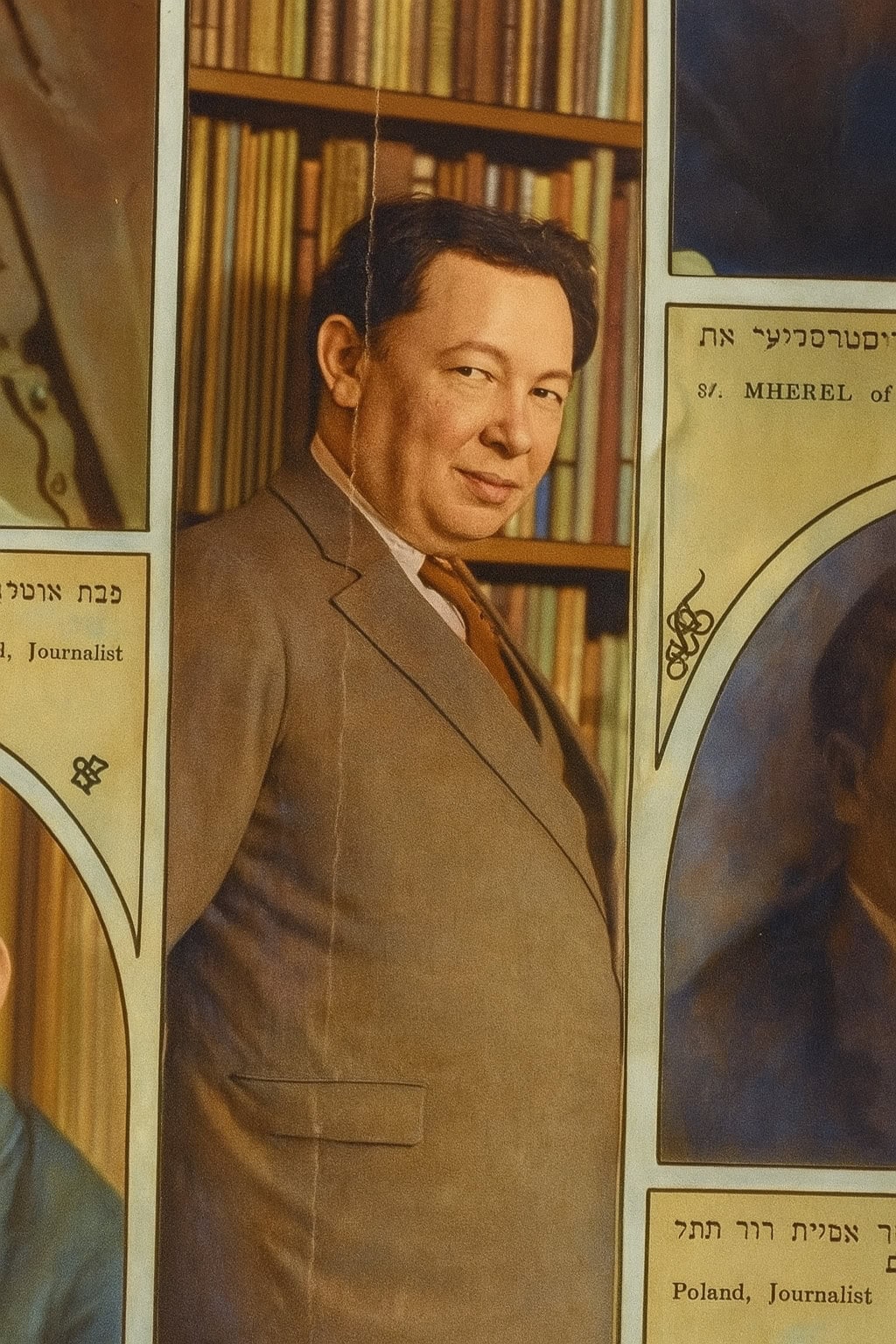
Yiddish scholar Zelig Kalmanovich was incarnated in the Vilna Ghetto following Nazi occupation and became a spiritual leader. He developed a philosophy of resistance based on learning from Jewish history and survival through keeping Jewish morals and humanity, engaging in cultural and educational endeavors and by doing so securing Jewish continuity. He rejected the military underground and supported the Judenrat’s obedience to the Germans. This is the main reason for Kalmanovich’s disregard from the collective history. Based on his diary, rare correspondence, and unique resources the article tells the story of an unusual man’s philosophy of resisting in ‘another way’.
Resistance in another way: the life and death of Zelig Kalmanovich, the ‘prophet’ of the Vilna Ghetto
This article by Dr. Daniela Ozacky Stern provides a comprehensive analysis of the life, worldview, and legacy of Zelig Hirsch Kalmanovich, a prominent Yiddish scholar and spiritual leader in the Vilna Ghetto. Known within the ghetto walls as “der navi” (the prophet), Kalmanovich developed a unique philosophy of “resistance in another way,” which prioritized spiritual resilience, cultural preservation, and adherence to Jewish history and morality over military rebellion. The study explores how Kalmanovich’s history-centric perspective offered a distinct approach to survival during the Holocaust and examines the historiographical reasons why his legacy was long marginalized in Israeli collective memory.
Born in 1881 in Courland to an impoverished family, Kalmanovich received a traditional Jewish education before pursuing extensive secular studies in philology, history, and political economy across Berlin, Königsberg, and St. Petersburg. Throughout his life, he faced continuous poverty but maintained a deep dedication to scholarship. After moving between several cities, he settled in Vilna in the late 1920s and became a central figure and editor-in-chief at YIVO (the Yiddish Scientific Institute). Although he initially engaged with secular, leftist, and Yiddishist political movements, his political activity waned as he focused on academic work, eventually developing strong Zionist leanings by the late 1930s following a visit to his son, Shalom, in Mandatory Palestine.
Following the Nazi occupation of Vilna in September 1941, Kalmanovich was incarcerated in the ghetto, where he underwent a profound spiritual transformation. Reconnecting with his religious and traditional roots, he developed a philosophical framework that viewed Nazi persecution through the lens of long-term Jewish history. He conceptualized the Jewish people as part of a sacred triad alongside the Torah and God, asserting that the war waged against the Jews was ultimately an attack on universal moral law and the Creator. Believing firmly that the spirit would triumph over physical brutality, Kalmanovich argued that the primary duty of the ghetto inmates was to maintain their humanity, moral integrity, and intellectual life.
Despite holding no formal administrative title, Kalmanovich emerged as a respected moral and spiritual authority. He delivered lectures, participated in literary and artistic associations, and engaged in extensive scholarly writing. As a leading figure in the scientific department of the “Paper Brigade,” he worked under German supervision during the ERR looting operations to sort Jewish archives and libraries, taking immense risks to hide and preserve irreplaceable cultural treasures in ghetto hideouts. He maintained that preserving Jewish books and historical records was the ultimate act of defiance, ensuring the continuity of the Jewish people beyond individual mortality.
Kalmanovich’s philosophy directly influenced his firm opposition to the armed underground movement (FPO) within the ghetto. In discussions with underground leaders like Aba Kovner, Kalmanovich argued against an armed uprising inside the ghetto, asserting that military confrontation against the German war machine was futile and would risk the immediate annihilation of the entire community. Instead, he advocated for maintaining stability, supported the pragmatic labor-oriented policies of the Judenrat leader Jacob Gens, and suggested that individuals seeking to fight should escape to the forests rather than imperil the ghetto population. His diary entries reflect a conviction that survival through labor, discipline, and cultural vitality offered the best chance for collective endurance.
In September 1943, during the final liquidation of the Vilna Ghetto, Kalmanovich was deported to the Vaivara/Narva forced labor camp network in Estonia. Despite severe physical degradation, hunger, and forced labor as a latrine cleaner, he continued to encourage fellow prisoners, delivering lectures and lighting Hanukkah candles in the barracks. He succumbed to hunger and illness in late 1943 or early 1944, and his body was cremated. His diary, written in real-time in Hebrew and Yiddish, was hidden in the ghetto, retrieved after the war, and eventually sent to YIVO in New York, serving as one of the most significant real-time accounts of the Vilna Ghetto.
The article concludes that Kalmanovich’s long-standing exclusion from the Israeli Holocaust pantheon stemmed from the post-1948 national ethos, which glorified armed combatants and partisans while scorning non-military forms of coping. His sympathetic stance toward the Judenrat and opposition to the FPO made his narrative unpalatable to early Israeli memory construction. However, as historiographical perspectives have broadened to acknowledge moral, spiritual, and cultural defiance, Kalmanovich’s history-centered philosophy stands as a vital model of intellectual endurance, proving his prophetic faith in the ultimate survival and renewal of the Jewish spirit.
Stern, D. O. (2021). Resistance in another way: the life and death of Zelig Kalmanovich, the ‘prophet’ of the Vilna Ghetto. Jewish Culture and History, 22(3), 253–271.
https://doi.org/10.1080/1462169X.2021.1952715